When buying pet furniture, many pet owners tend to make the same two mistakes.
Some people simply follow online trends and buy whatever product is popular. Others rely on intuition and choose something that “looks about the right size.”
The result is often disappointing.
Either the furniture ends up unused because the pet doesn’t like it, or it breaks quickly due to poor materials. In some cases, low-quality materials may even pose health risks to pets.
In reality, choosing the right pet furniture isn’t complicated.
It comes down to three simple principles:
Material safety is the foundation, proper sizing is essential, and functional design determines whether pets will actually use it.
Once you understand these principles, selecting the right furniture becomes much easier.
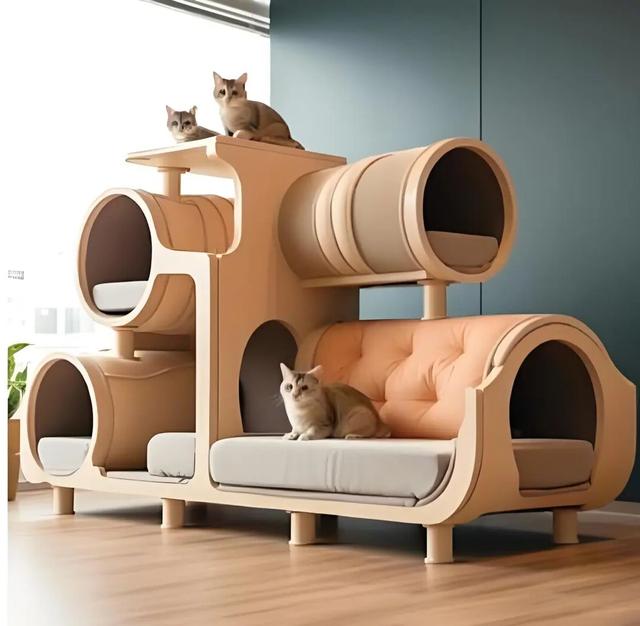
1. Materials Matter Most: Understanding Wood-Based Furniture
Many people assume that all “wood furniture” is roughly the same.
In reality, there are huge differences between different wood materials used in furniture manufacturing.
Solid wood is wood.
But wood dust compressed into boards is also technically wood.
Without understanding these differences, it’s easy to be misled by marketing terms.
For households with pets, material choice becomes even more important. Cats and dogs naturally chew or scratch furniture, and low-quality materials may break easily or even be swallowed accidentally.
A simple rule of thumb is:
-
Avoid: low-quality MDF or particle board
-
Acceptable: plywood or blockboard
-
Best option: solid wood or FSC-certified wood materials
Let’s briefly understand how these materials differ.
Solid Wood Furniture
Solid wood furniture is made directly from cut sections of natural timber.
Its advantages include:
-
Excellent durability
-
Strong structural stability
-
Natural aesthetics and texture
-
Repairable surface scratches
Traditional wooden furniture, such as dining tables or school desks, can often last for decades.
For pet furniture, solid wood performs well because it is more resistant to scratching and general wear.
The only drawback is that it tends to be more expensive.
Solid Wood Frame Furniture
This is a very common structure in modern furniture.
The main load-bearing structure is made from solid wood, while other parts use engineered panels.
For example:
-
Table legs made of solid wood
-
Frame structure made of solid wood
-
The center panel made from plywood or other composite materials
This approach maintains structural strength while reducing overall cost.
As a result, solid wood frame furniture usually offers a good balance between durability and price.
Plywood (Multi-Layer Board)
Plywood is constructed in layers, somewhat like a layered cake.
Thin sheets of wood veneer are stacked cross-grain and bonded under high pressure and temperature.
This structure provides several advantages:
-
High structural stability
-
Reduced risk of warping
-
Better moisture resistance than many engineered boards
Many high-quality furniture products use plywood as a core material and apply a natural wood veneer on the surface for appearance.
When produced under strict environmental standards (such as ENF formaldehyde emission standards), plywood is a very reliable choice.
Blockboard
Blockboard uses strips of wood glued together to form a core layer, which is then covered with wood panels on both sides.
It is commonly used in cabinetry and interior construction.
Blockboard can be strong and stable, but one important factor must be considered:
The more adhesives involved in production, the higher the potential formaldehyde emissions.
When purchasing furniture, always check environmental certifications such as:
-
ENF formaldehyde standards
-
FSC wood certification
MDF (Medium Density Fiberboard)
MDF is made from fine wood fibers mixed with resin and adhesives, then compressed into panels.
Its advantages include:
-
Very smooth surface
-
Easy to machine and shape
-
Low production cost
However, it also has several drawbacks:
-
Swells easily when exposed to moisture
-
Lower structural strength
-
Easier for pets to chew or damage
If you have ever seen furniture panels that swell or “bubble up” after water exposure, it is usually MDF.
For pet households, MDF is generally not recommended.
Particle Board
Particle board is made by compressing wood chips and particles with adhesives.
It is widely used in affordable furniture.
Its benefits include low cost and efficient manufacturing.
However, there are also limitations:
-
Large variation in quality
-
Potentially higher formaldehyde emissions
-
Lower strength compared to plywood or solid wood
For pets that tend to chew on furniture, particle board can also break apart easily.

2. Surface Materials: HPL vs Melamine
When shopping for furniture, you may often see terms like:
“Laminate surface”
“Melamine finish”
Many people confuse these two materials.
High-Pressure Laminate (HPL) is a decorative surface created by pressing layers of kraft paper and decorative paper under high temperature and pressure.
Its advantages include:
-
Moisture resistance
-
Scratch resistance
-
Heat resistance
-
High durability
For this reason, HPL is widely used in kitchens, cabinets, and work surfaces.
Melamine, on the other hand, is a resin coating applied to boards such as particle board.
A typical structure is:
Particle board + melamine coating
In terms of durability:
HPL surfaces are generally stronger and more durable than melamine finishes.
If possible, choosing furniture with HPL surfaces will usually provide better long-term performance.
3. Size Matters: Proper Dimensions Ensure Comfort
While materials ensure safety, size determines whether pets will actually use the furniture.
Many pet products go unused simply because the dimensions are not suitable.
Examples include:
-
Dog beds that are too small to stretch out
-
Feeding bowls placed too low, causing neck strain
-
Cat trees that are not tall enough to satisfy climbing instincts
Here are some simple sizing guidelines.
Dog Furniture Sizing
Bed length
= Nose to tail base length + 20 cm
Bed width
= Shoulder width + 15 cm
Feeding bowl height
= Shoulder height × 0.4
Proper bowl height helps reduce neck and spine strain.
Cat Furniture Sizing
Cat bed length
= Body length × 1.2
Cat bed width
= Body length × 0.8
Cat tree height
= Sitting height × 2.5
For larger breeds such as Ragdolls or Maine Coons, cat trees are usually recommended to be at least 180 cm tall.
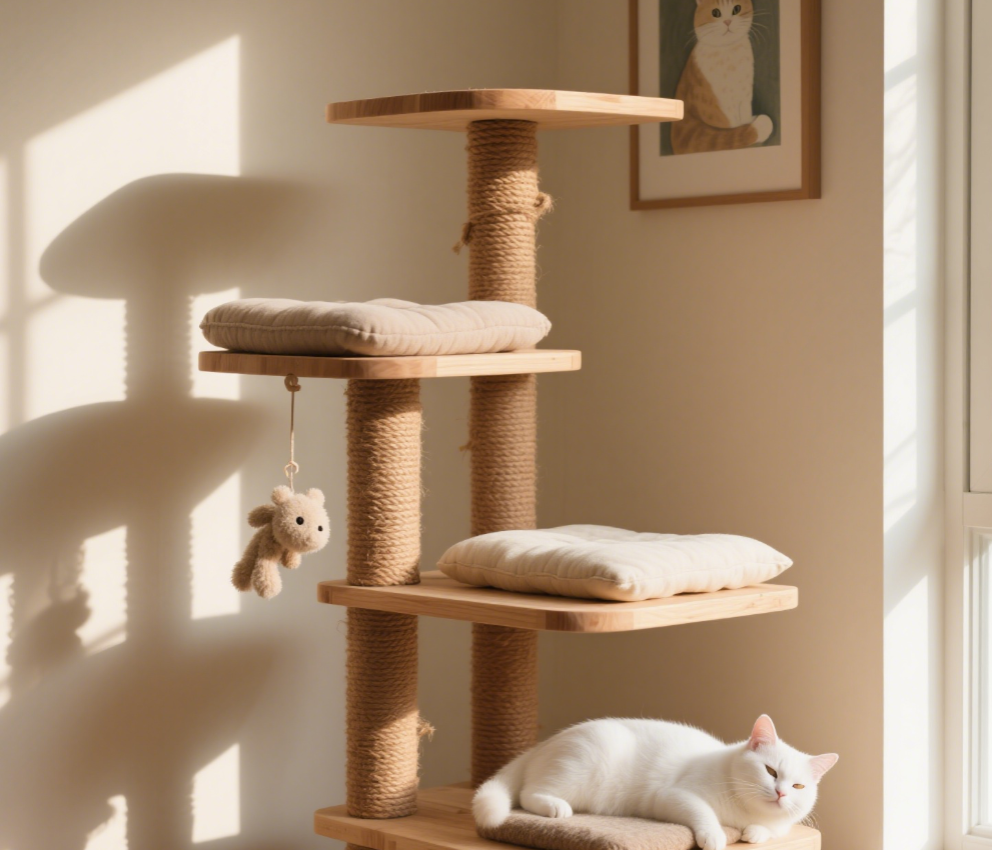
4. Functionality: Match Furniture to Natural Behavior
Pet furniture only works if it aligns with natural animal behavior.
For example, cats naturally:
-
Love climbing
-
Need scratching surfaces
-
Prefer hiding spaces
Therefore, ideal cat furniture usually includes:
-
Multi-level structures
-
Sisal scratching posts
-
Tunnels or enclosed spaces
Dogs have different needs.
Dogs typically:
-
Prefer comfortable resting spaces
-
Chew objects frequently
-
Need room for movement
Suitable dog furniture might include:
-
High-resilience foam beds
-
Foldable playpens
-
Durable toy storage solutions
5. A Simple 5-Step Method for Choosing Pet Furniture
If you want to avoid common mistakes, follow this process.
Step 1: Measure your pet
Record body length, shoulder width, and height.
Step 2: Check materials
Look for certifications such as:
-
ENF formaldehyde standard
-
FSC wood certification
Step 3: Evaluate functionality
Choose furniture that fits your pet’s natural habits.
Step 4: Inspect build quality
Check edges, hardware connections, and finishing details.
Step 5: Consider long-term value
Durable materials may cost more upfront but last significantly longer.
Pet furniture is often seen as a simple household purchase.
In reality, it affects several important aspects of daily life:
-
Pet health and safety
-
Household cleanliness
-
Furniture durability
-
Long-term maintenance costs
When making a decision, the correct priority should always be:
Material Safety → Proper Size → Functional Design → Appearance
Once these elements are properly balanced, pet furniture becomes more than just an accessory—it becomes a natural and functional part of the home environment.
