Let’s be honest.
Most bedrooms don’t have nightstands because people need them.
They have them because they’ve always been there.
Two identical boxes, one on each side of the bed.
Symmetrical. Safe. And most of the time—completely unnecessary.
They take up space, interrupt movement, collect clutter,
and somehow still fail to solve real problems.
So instead of asking:
“Which nightstand should I buy?”
A better question is:
👉 “Do I even need one?”
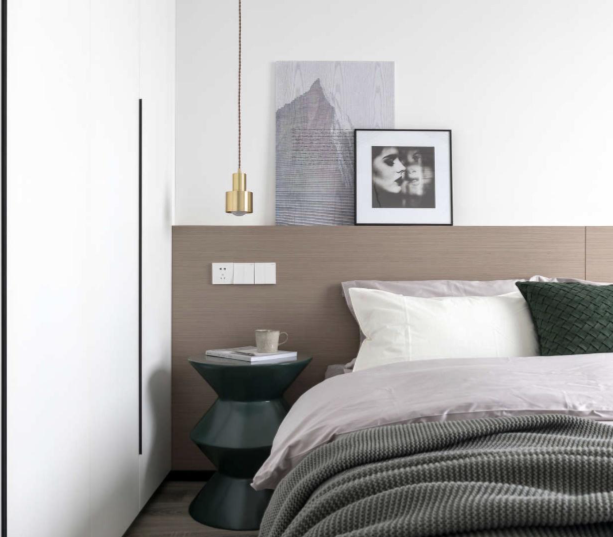
Small bedrooms don’t need furniture. They need decisions.
In tight spaces, every centimeter is a negotiation.
A traditional nightstand often becomes the first thing that doesn’t fit—
blocking wardrobe doors, narrowing walkways, making the room feel heavier than it is.
That’s why the smartest solutions don’t add furniture.
They remove it, merge it, or shrink it until it disappears.
Built into the bed, not placed beside it
Instead of placing a nightstand next to the bed,
make it part of the bed.
An integrated bedside unit eliminates gaps, awkward corners, and dust traps.
More importantly, it removes the visual “break” that makes small rooms feel fragmented.
Done right, it doesn’t look like furniture.
It looks like the room was designed as one piece.
When 20cm is enough
People overestimate how much space they actually need beside the bed.
A 15–20cm narrow cabinet can hold everything essential:
phone, glasses, a book, maybe a glass of water.
We’ve used this in real projects—continuous slim cabinets running along the bed,
sometimes with hidden storage under a flip-top.
From the outside, it looks minimal.
Inside, it works harder than a standard nightstand ever could.
👉 The point isn’t size.
It’s whether the space is doing its job.
If the floor is crowded, go to the wall
Wall-mounted shelves solve two problems at once:
- They free up floor space
- They make cleaning easier
But more importantly, they visually “lighten” the room.
Pair it with a slim vertical storage piece slightly away from the bed,
and suddenly the bedside area feels intentional—not squeezed in.
Walls are not just boundaries. They’re opportunities.
In small bedrooms, unused wall thickness is wasted space.
If the wall allows it, carving out an alcove changes everything.
A 30cm-deep niche can replace a nightstand entirely—
and feel like it was always meant to be there.
When combined with wardrobes,
it stops furniture from competing with each other
and turns the whole room into a system.
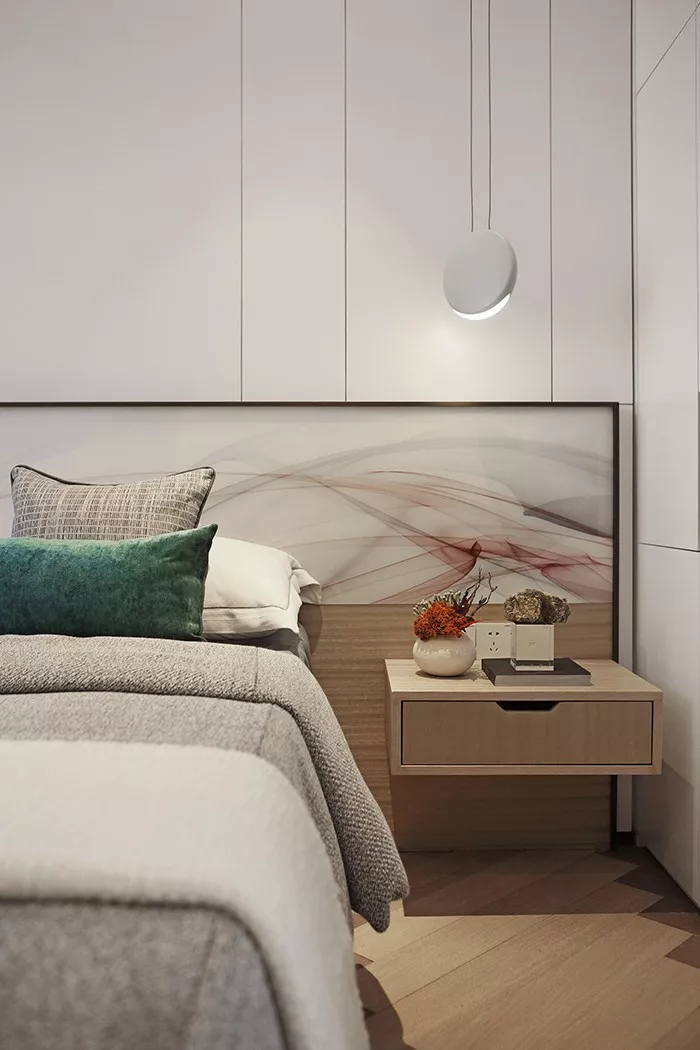
A bedside should do more than hold a phone
Most nightstands are underused.
They exist, but they don’t contribute.
So instead of adding more storage,
a better approach is:
👉 Make the bedside part of something bigger
Bed + desk: where space starts working
In smaller homes, rooms don’t have single functions anymore.
A bedside can extend into a desk—
not as an add-on, but as a continuation.
The proportions matter:
- At least 800mm in length to be usable
- Around 500mm in depth for comfort
When done right, it doesn’t feel like a compromise.
It feels like the room finally makes sense.
A vanity isn’t extra—it’s placement
A dressing table doesn’t require another room.
It requires the right position.
The bedside is often the most overlooked option.
The real key here isn’t the table.
It’s the lighting.
Bad lighting ruins the function.
Good lighting turns a simple surface into a daily ritual space.
One corner, multiple roles
A bedside can extend into a sofa,
or connect into a small desk.
Not everything needs to be separated.
Especially in smaller homes,
a single corner that supports multiple activities
is more valuable than perfectly defined zones that don’t get used.
Sometimes the best solution is the least fixed one
Not everything has to be built-in.
Some of the most practical solutions are the ones that move.
The trolley: underestimated, but honest
A mobile trolley isn’t trying to look like a design statement.
It just works.
You move it where you need it.
You take it out when you don’t.
No commitment, no dead space, no cleaning problems.
In a way, it’s more aligned with how people actually live.
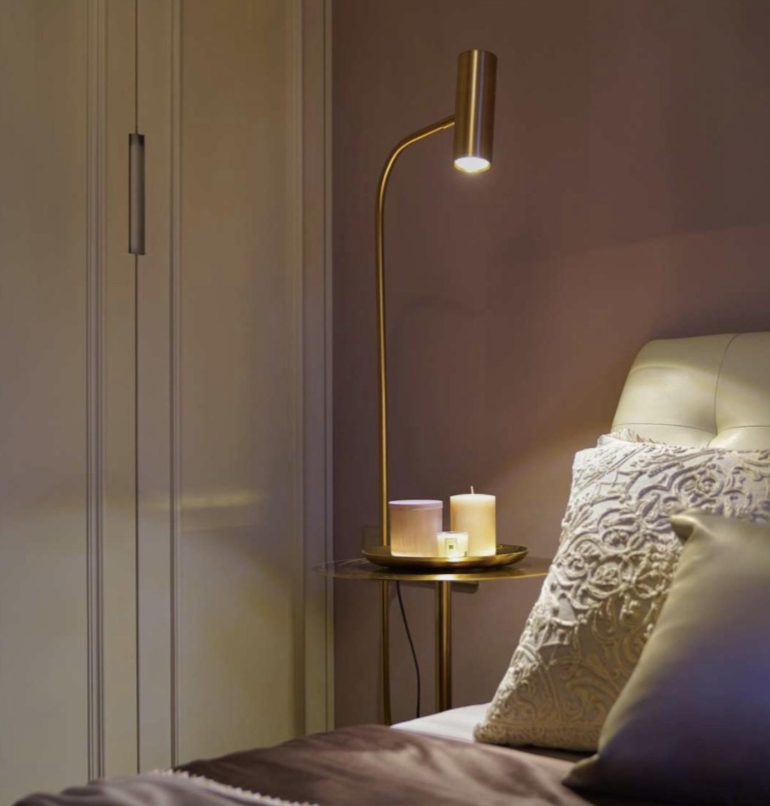
A side table and a lamp—nothing more, nothing forced
Instead of forcing storage,
sometimes all you need is a surface and good light.
A small side table paired with a floor lamp
creates a softer, more flexible bedside setup.
It doesn’t try to solve everything.
But it solves the right things.
Storage doesn’t have to be separate
If you already have a wardrobe,
why add another piece of furniture?
An open niche within the wardrobe can function as a bedside.
It’s subtle, efficient, and avoids redundancy.
In smaller rooms,
this kind of integration matters more than buying “one more thing.”
The mistakes most people don’t notice
Most problems don’t come from bad taste.
They come from things nobody planned early enough.
- Sockets placed too far → daily inconvenience
- Lighting treated as decoration → poor usability
- Standard sizes forced into non-standard rooms → wasted space
Good design isn’t about adding.
It’s about aligning.
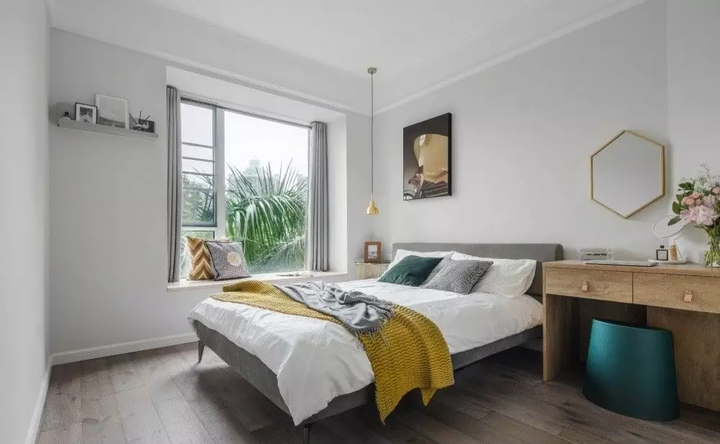
One last thought
A bedroom doesn’t need to follow a template.
The two-nightstand layout survived this long
not because it’s optimal—
but because nobody questioned it.
But once you do, you realize:
👉 A bedside is not a piece of furniture.
It’s a function.
And functions don’t need to look the same in every room.
So the next time you design a bedroom,
don’t start with what’s “supposed to be there.”
Start with how you actually live.
Everything else becomes easier after that.
